
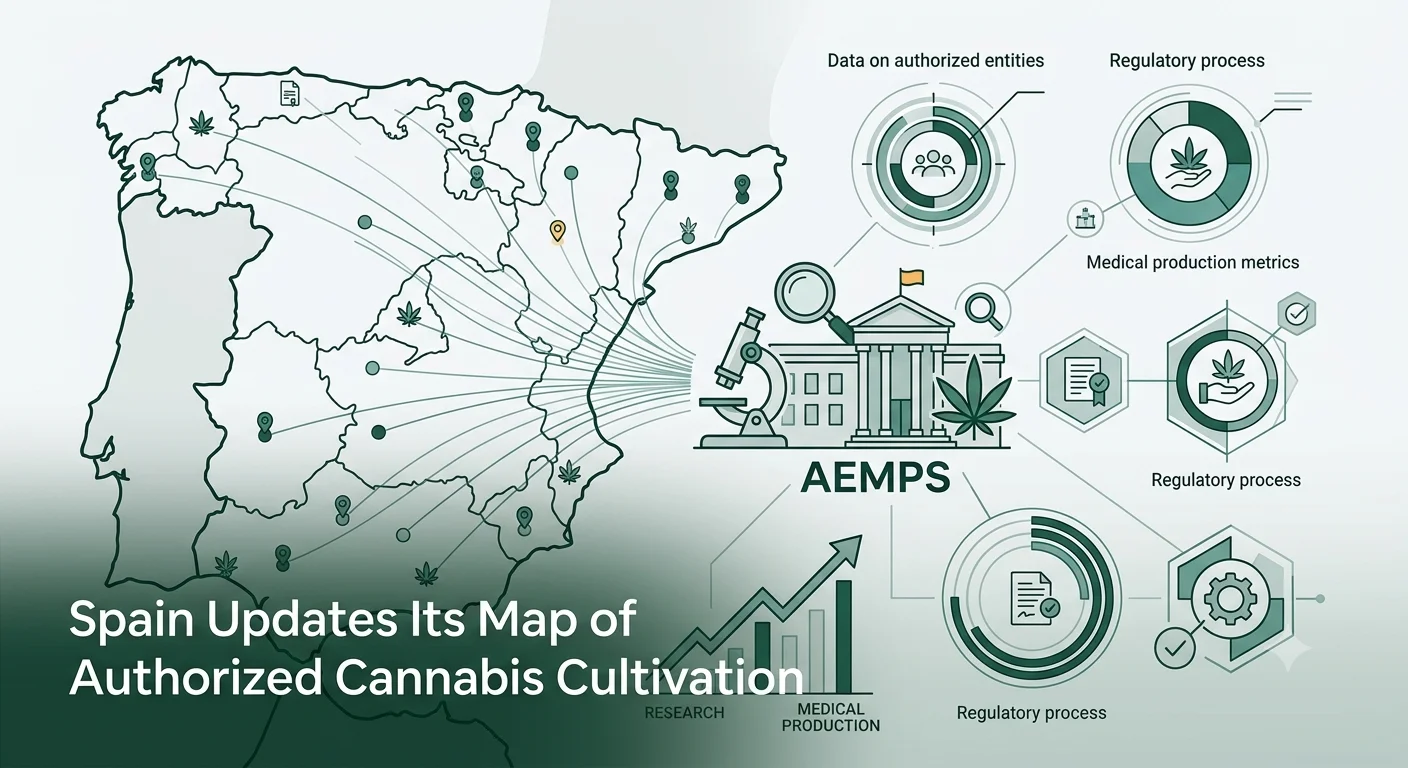
Spain is currently reshaping its commercial cannabis landscape. According to the latest official records from the Spanish Agency of Medicines and Medical Devices, known locally as theAEMPS, the country currently maintains 22 active authorizations for cannabis cultivation. These permits are held by 20 distinct entities, revealing a noticeable shift away from early stage research and toward commercial medical production.
While the total number of licenses offers a clearer look at who is allowed to grow under state supervision, it also highlights the strict boundaries surrounding the industry.
The Numbers Behind the AEMPS Licenses
The 22 active authorizations granted by the AEMPS fall into three specific categories:
- Medical and Scientific Production:9 authorizations cover commercial manufacturing and cultivation aimed at medical supply.
- Research Projects:8 authorizations are designated strictly for scientific study and genetic research.
- Process Validation:5 authorizations permit the cultivation of specific plant batches to validate manufacturing processes for narcotic active pharmaceutical ingredients.
The total count of 22 permits does not mean 22 separate business entities exist in the space. Two prominent players, Bhalutek Sens and Phytoplant Research, hold dual authorizations for both research and medical production. That brings the actual count of unique authorized cultivators in Spain to exactly 20.
Among the entities approved for commercial medical production are recognized names including Cannaflos Genetics, Linneo Health, Medical Plants, Naturhemp, Oils4Cure, Ondara Directorship, and Sovereign Fields, alongside the two dual license holders.
A Clear Pivot From Research to Production
A comparison with historical records from 2023 demonstrates how rapidly the focus of Spanish cannabis cultivation is changing. Three years ago, the AEMPS registry showed 16 research permits, six medical production licenses, and two process validation approvals distributed among 21 entities.
In the current landscape, research licenses have plummeted by half. Conversely, commercial production licenses and process validation permits have surged.
This trend signals that the domestic industry is maturing beyond initial lab trials. Companies are increasingly seeking market readiness, commercial scale, and standardized production processes to supply pharmaceutical supply chains.
Regulatory Hurdles and Operating Conditions
Securing an initial authorization from the AEMPS does not give a company immediate approval to plant seeds. Operating within Spain requires passing several regulatory layers.
Research authorizations are granted for fixed timeframes and require periodic renewal based on project milestones. For commercial medical production, holders must obtain parcel specific site authorizations before starting any crop cycles. On top of that, every licensed company must submit comprehensive annual reporting to state regulators detailing their operations.
Transparency and the Legal Scope
For years, the assignment of cannabis licenses in Spain operated under significant public opacity. That began to change following a landmark resolution from the Transparency and Good Governance Council, which instructed the Ministry of Health to release detailed criteria regarding permit conditions.
The current public registry improves traceability by listing active holders and approved purposes. However, key commercial metrics remain private. The registry does not publish total cultivated acreage, annual yield weights, commercial supply contracts, or specific export destinations.
This distinction is especially relevant following the implementation ofRoyal Decree 903/2025, which established the regulatory framework for standardized cannabis magistral formulas in Spain. Under this law, prescription power is restricted exclusively to hospital medical specialists, while preparation and distribution are confined to hospital pharmacies.
Because of these tight restrictions, holding a cultivation license makes a company part of a strictly controlled pharmaceutical supply chain, yet it does not guarantee immediate product availability for domestic patients.
What This Means for the Spanish Cannabis Market
The updated registry proves that Spain possesses a legal cultivation framework that is far more extensive than many industry observers realize. Twenty commercial and research entities now operate under direct government supervision.
At the same time, this regulatory framework remains tightly fenced. Commercial licenses cater almost exclusively to pharmaceutical supply chains and export markets. Meanwhile, personal cultivation, social clubs, and adult use markets remain entirely outside this official framework.
Cannabis Clubs Near You
Explore the best cannabis clubs in Barcelona